


The Strategic Customer Agreements are real and they change the downside. They do not make today’s 85% margin the one that lasts.
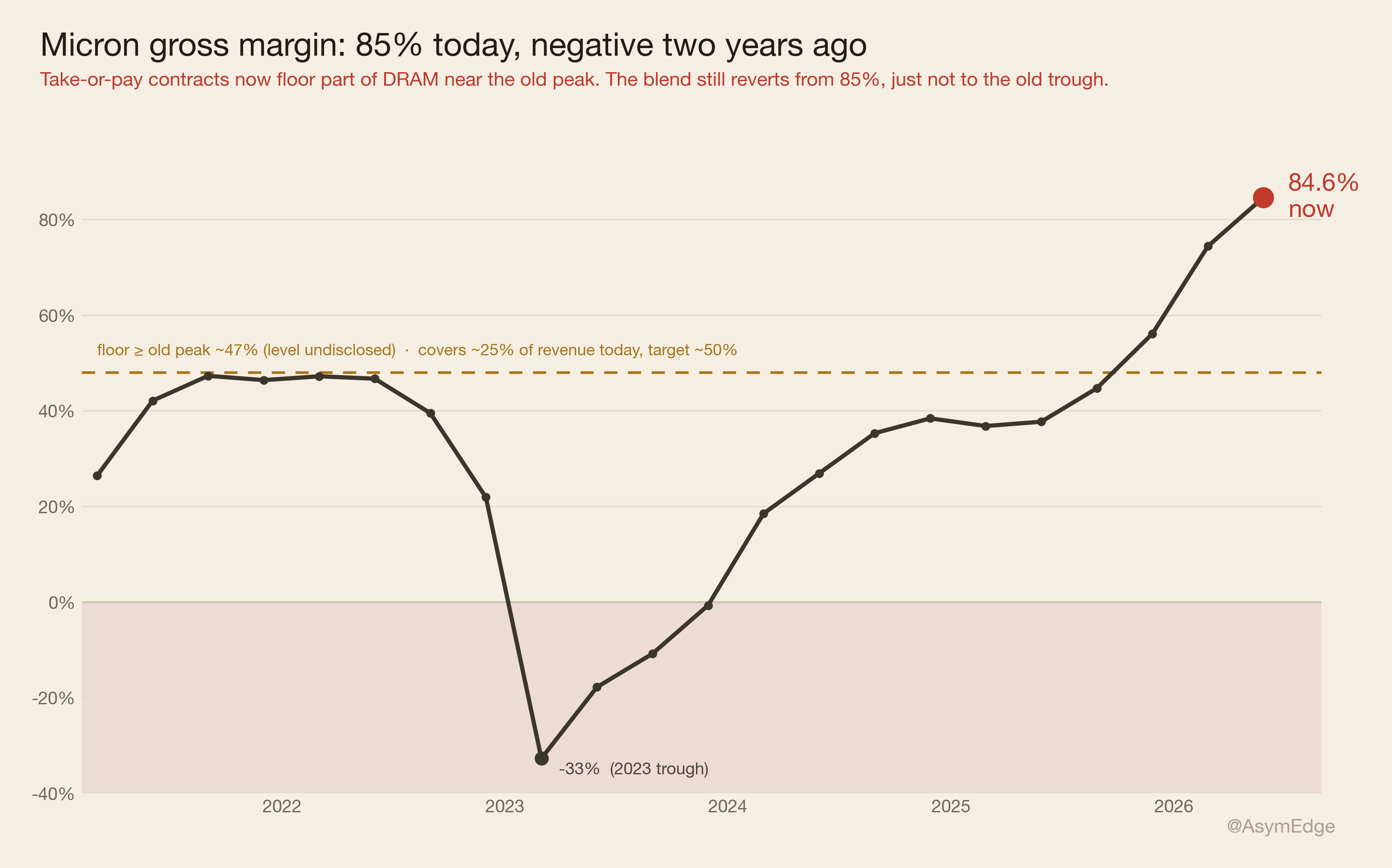
Micron just did $41.5 billion in revenue, up 74% from the prior quarter, at an 84.6% gross margin. EPS was $25.11 against a $20.98 estimate. The stock jumped about 15% overnight, and management guided next quarter to $50 billion.
The headline beat is not the story. The story is what management disclosed underneath it: roughly $100 billion of contracted minimum revenue across 16 Strategic Customer Agreements, with floor pricing, running through 2030.
I came in expecting a bumpier climb than this. The blowout, and the five-year contracts behind it, are more than I had expected. The contracts changed how I see the downside.
The bull case is real, and stronger than it looks
The contracts deserve credit: memory has never locked in volume and floor pricing five years out.
These are take-or-pay agreements. Non-cancellable. Backed by about $22 billion of customer financial commitments, including upfront cash deposits. The floor prices guarantee gross margins above any level Micron reached in any prior cycle.
Take-or-pay only gets signed when the seller has the leverage. In a glut, buyers wait and pick up cheap spot; they do not lock five years. Micron’s biggest customers committing multi-year volume and billions in upfront deposits is the buyers themselves saying memory is genuinely scarce, and expecting it to stay that way. That is revealed preference, paid in cash.
So the contracts are two things at once: hard downside protection, and a live signal that the demand is real. The bull case is right to lead with both.
A floor only protects the downside
Here is where the bull case overreaches.
A floor is a minimum, not an expected price. The contracts tell you the downside on covered volume is high, above the old ~47% peak. They do not tell you the durable margin is 85%. Those are different numbers, and the gap between them is the whole debate.
The coverage math makes it concrete. About 25% of revenue is contracted today, heading toward management’s ~50% target. The other ~75% is still sold at spot, still cyclical, and it is that spot-exposed majority, priced at today’s shortage peak, doing most of the work in an 84.6% blended margin.
When spot normalizes, and all three suppliers are building capacity to make sure it does, the blend falls. It no longer falls to negative 33%, because a quarter of revenue is floored. But it falls a long way from 85%.
The floor moved up. The ceiling did not move with it.
Where Micron sits in the chain
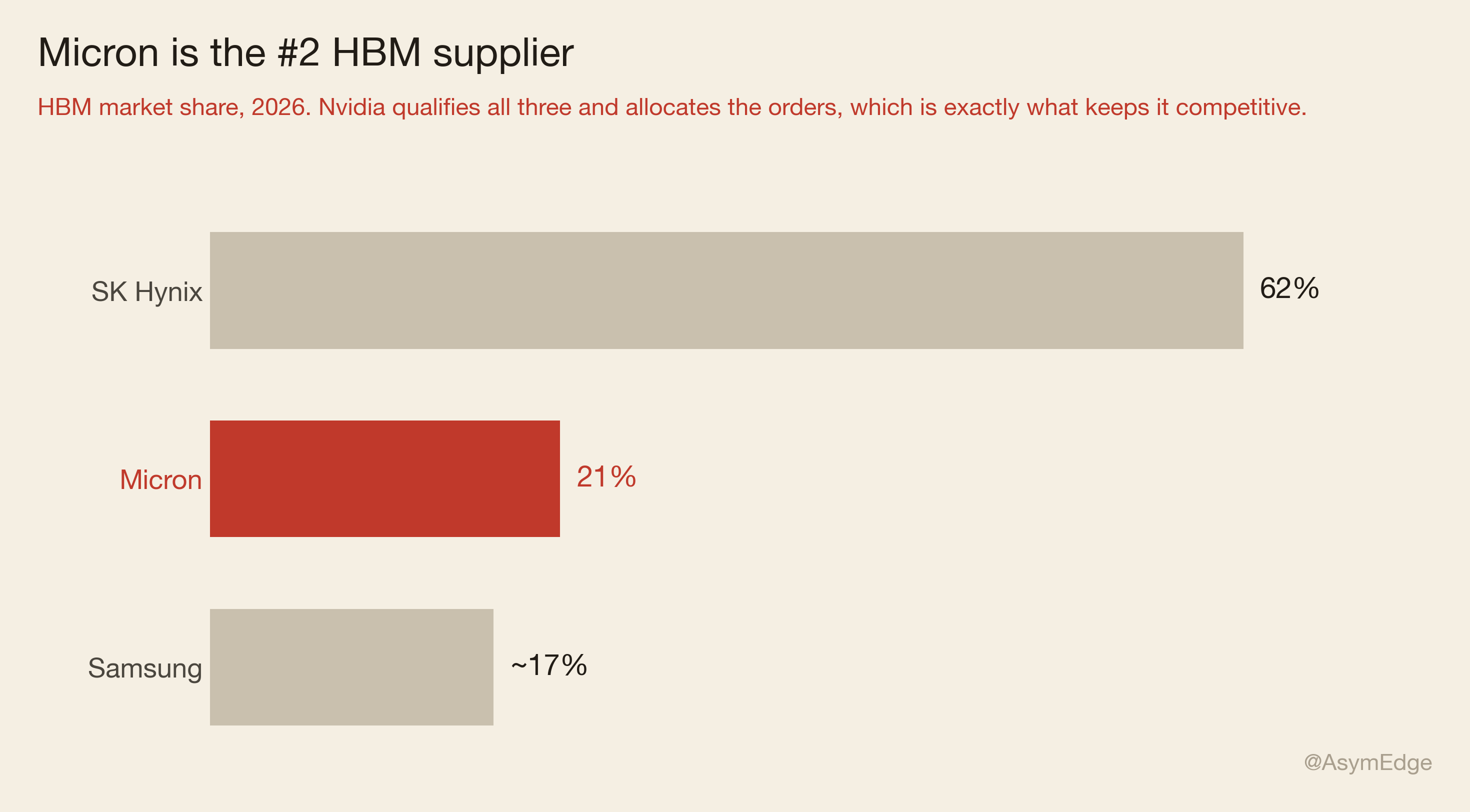
Micron is one of three qualified HBM suppliers, the #2 behind SK Hynix. It sells HBM into the accelerator makers, Nvidia, AMD, and the hyperscalers’ custom chips, rather than controlling the platform itself, and unlike Nvidia or TSMC it sits in the most competitive layer of the chain. Nvidia, the largest buyer, qualifies all three memory makers and splits its orders between them, which is what keeps the layer competitive.
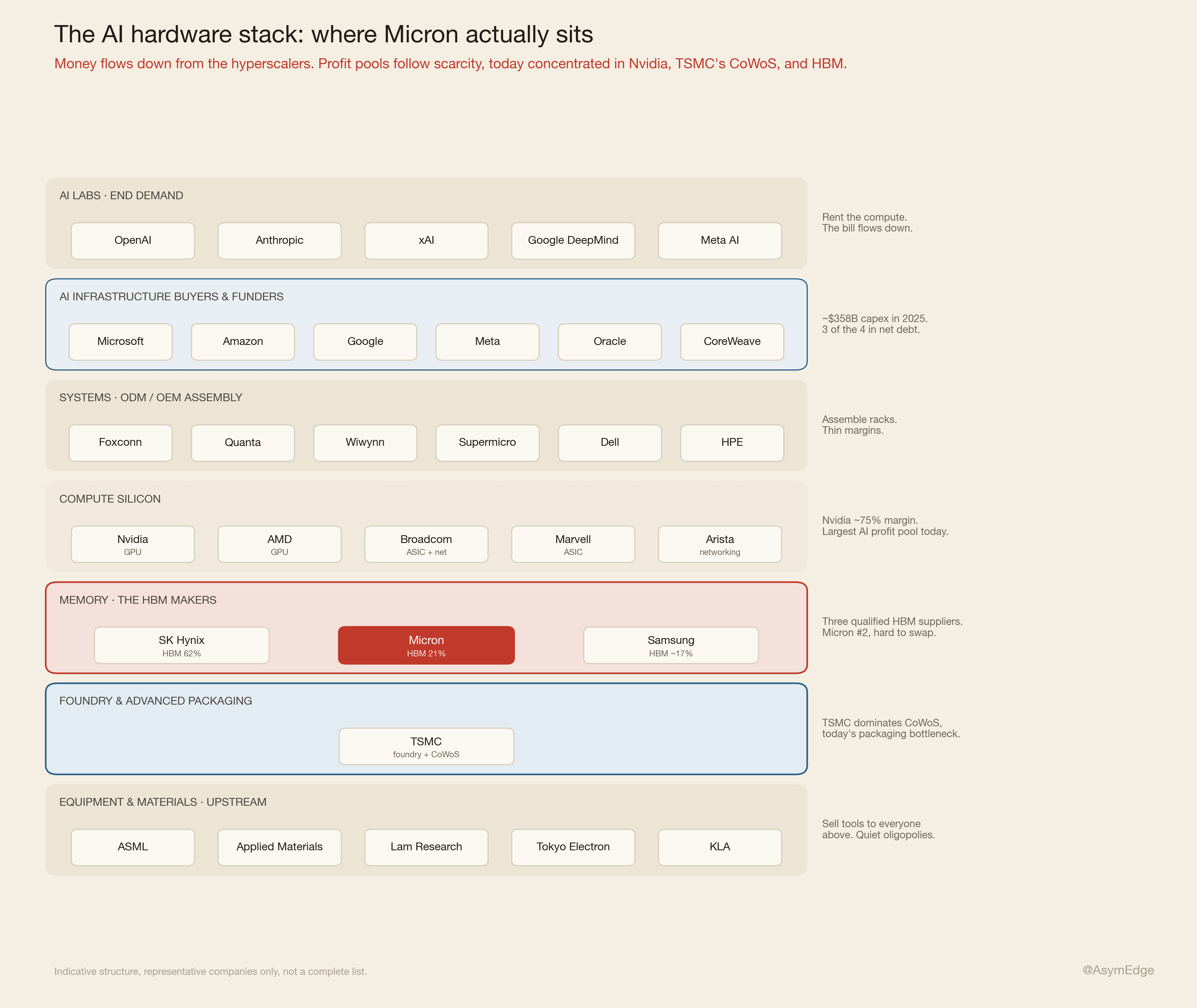
Competitive does not mean easy to enter. Qualifying into Nvidia is a multi-year moat. Samsung, the third supplier, failed Nvidia’s 12-layer HBM3E test repeatedly from early 2024 to late 2025, close to eighteen months, while Micron qualified earlier and turned it into share. So the layer has three players, but the door is heavy, and a customer who signs a five-year deal cannot casually swap memory suppliers. That is what makes the floor pricing credible. It guards the floor while leaving the 85% exposed: the same capacity the three keep adding is what pulls the spot-priced majority back down.
The tell: Micron is out-earning the monopolies above it
The cleanest evidence that 85% is a cyclical peak sits in the margin stack itself.
Micron now earns the highest gross margin in the entire AI hardware chain. Higher than Nvidia, which sets the GPU standard and decides how the HBM orders get split. Higher than TSMC, the only fab that matters and the owner of the packaging chokepoint.
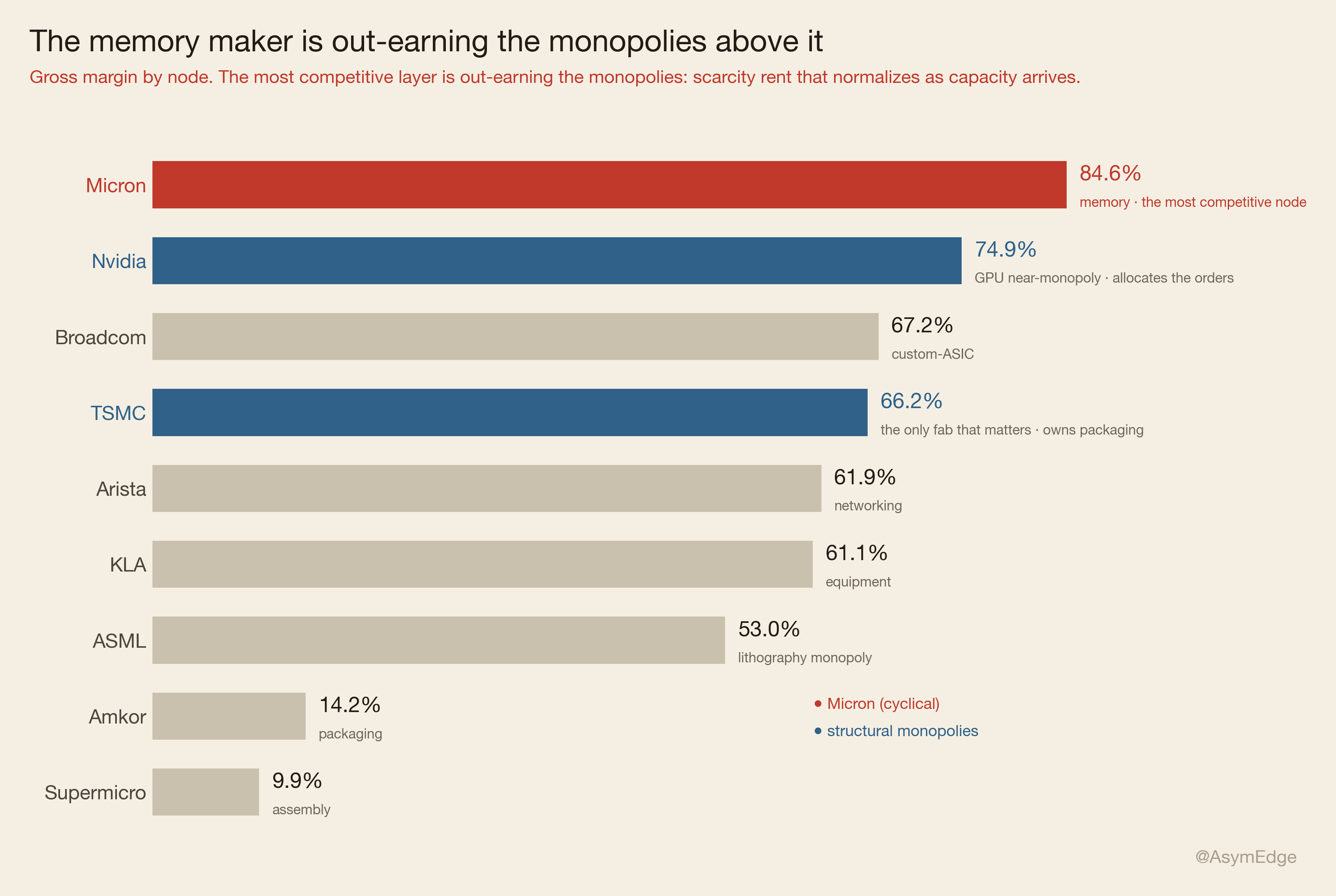
In a durable value chain, the structural monopolies earn the highest returns. Today the opposite is happening. The most competitive node, the one Nvidia keeps three suppliers of on purpose, is out-earning the two companies with the most durable power above it.
When a scarce input out-earns the monopolies it sells into, that is scarcity rent. As the three qualified suppliers add capacity, it normalizes. Memory has run this play before.
Valuation, and the trap inside it
If today’s margins hold, the stock is cheap. It is priced like a commodity chip company even as a quarter of its revenue becomes contracted and recurring.
The most bullish read goes further: it argues the old valuation models no longer apply because the industry has structurally changed, and the stock is cheap even at a single-digit multiple. Be careful. That multiple is only low because it sits on peak-margin earnings. Value Micron on its durable plateau instead, and the same price is a higher multiple on lower earnings.
“It’s different this time” is occasionally right and is always what the top sounds like. The contracts make that argument more credible than usual. They do not make it free.
What it means
I did not expect a print this strong, or contracts this durable behind it. I was long into it and still underestimated the magnitude. The business is in great shape. My skepticism is narrower: a price that treats 85% margins as permanent.
Micron is still my largest position, and I am holding it for now, sized for the plateau rather than the peak. The tells I am watching: realized gross margin against the roughly 86% guide, how fast coverage climbs toward half of revenue, and HBM4 share. Micron sits around 20% there, and each generation resets the qualification race. Its HBM3E lead does not carry over automatically, and SK Hynix already holds most of the early HBM4 orders. A soft HBM4 ramp would undercut the durable-share half of the case.
If coverage grows and the floor holds, the plateau thesis wins. If spot normalizes faster than the contracted base grows, the de-rate from 85% comes first.
Micron stopped being a pure commodity this quarter. It did not become an 85%-margin franchise. The truth, and the opportunity, sits in between.
I’ll post updates as those tells play out. Subscribe if that’s the kind of work you want in your inbox.
Disclosure: I am long Micron, and it is currently my largest position. This reflects my own research and opinion, not investment advice. Please do your own research before investing.