
The AI selloff hasn't reached earnings yet. Oracle shows how it could.
A sharp selloff split AI buyers, builders and suppliers. I examine who can keep funding the build, why I added to Sandisk, and what would change my mind.
|
Weekly · the market and its twelve most-traded stocks
The AI selloff hasn't reached earnings yet. Oracle shows how it could.
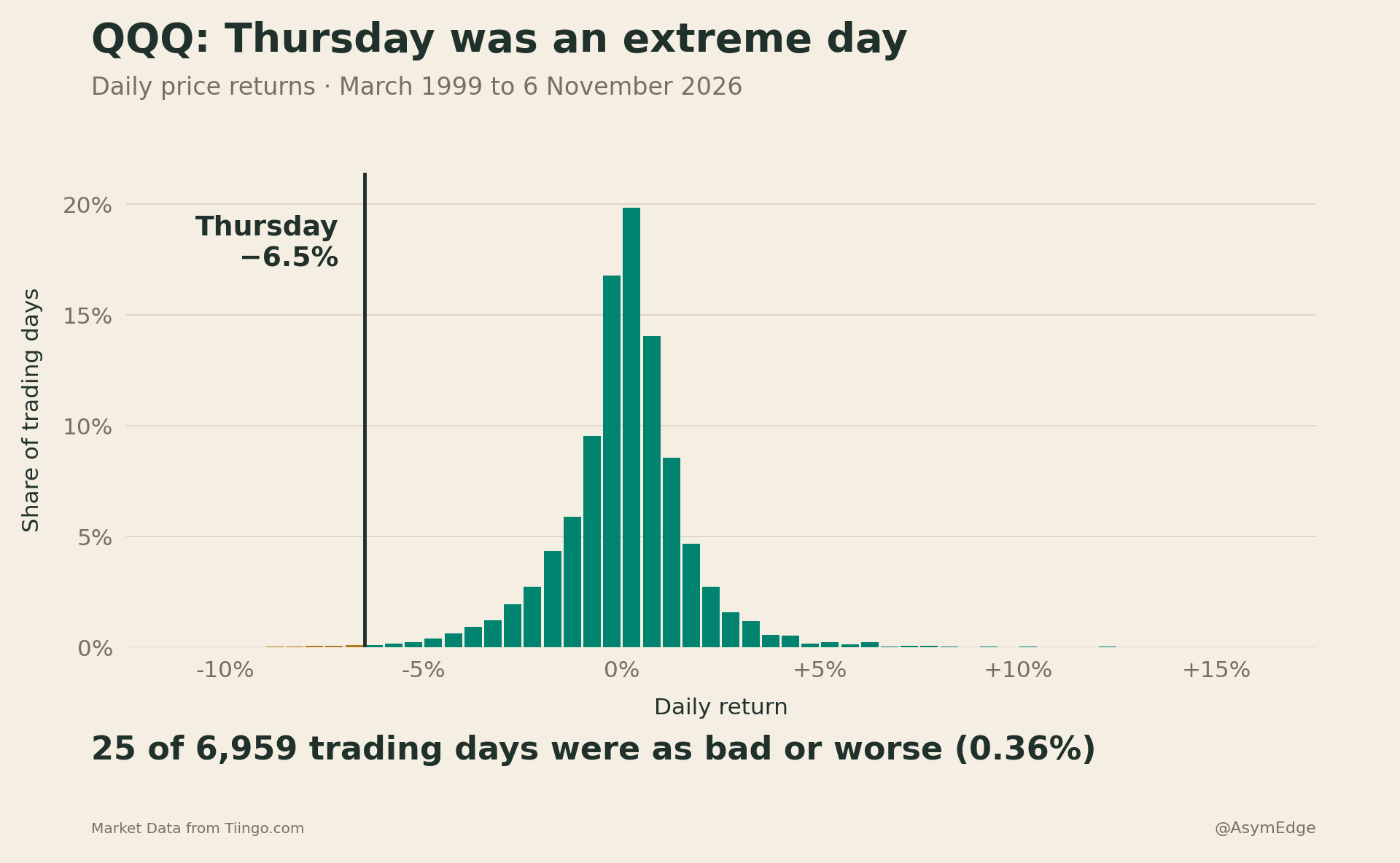
QQQ fell 6.5% on Thursday, its worst day since 16 March 2020. Fears of data-center restrictions after the midterms, Qualcomm's smartphone-chip sales miss and AI financing costs weighed on sentiment. Investors were selling out of popular AI trades. Traders also feared that leveraged ETFs would have to sell after the sharp fall, pushing prices down further. Friday's rebound still left QQQ down 5.0% for the week.
Inside AI, the week split three ways. Hyperscalers buying chips and servers for their AI infrastructure held up: Amazon, Alphabet and Microsoft rose, while Meta slipped less than 1%.
Cloud builders reliant on outside funding fell. Oracle and neoclouds CoreWeave, Nebius and IREN lost roughly 10% to 16%.
Memory suppliers were hit harder: Micron lost 22% and Sandisk 27%.
Most AI earnings forecasts have held up. My reading is that investors fear higher funding costs will force buyers to cut spending. Oracle completed a $20 billion sale of shares and bonds on 4 November, paying 7.0% to 8.65% interest on the bonds. If expensive funding leads to fewer data centers being built, suppliers sell fewer chips and memory, and their earnings suffer.
My view is that prices discount more lasting damage than the evidence supports. I expect the global AI build to continue, and I used the selloff to add to Sandisk. The test is whether buyers can keep funding and delivering the spending behind suppliers' forecasts.
Who can keep building?
Policy and financing worries could slow the data-center build. I think investors saw a possible benefit for the hyperscalers: lower spending would leave them with more cash. For Oracle and the neoclouds, delays would push back new capacity and revenue. For chip and memory suppliers, they would mean fewer or later orders. Spending less only helps the hyperscalers if they can still meet demand.

Investors had already punished heavy spending. Meta fell 7% on 22 October after raising its spending forecast and announcing plans to sell more shares.
Over the last four reported quarters, Microsoft paid $69 for property and equipment for every $100 its business generated in cash. Alphabet and Meta also spent less than they generated over that period, but more in the latest quarter. Amazon spent more over both periods. That gap has to be covered by cash reserves or outside funding.
Over their last four reported quarters, Oracle spent $161 and CoreWeave $298 for every $100 generated in cash from operations. Oracle's deal shows it can still raise money, but the new bonds add about $760 million in interest each year. Its expansion needs to earn enough to cover that bill.
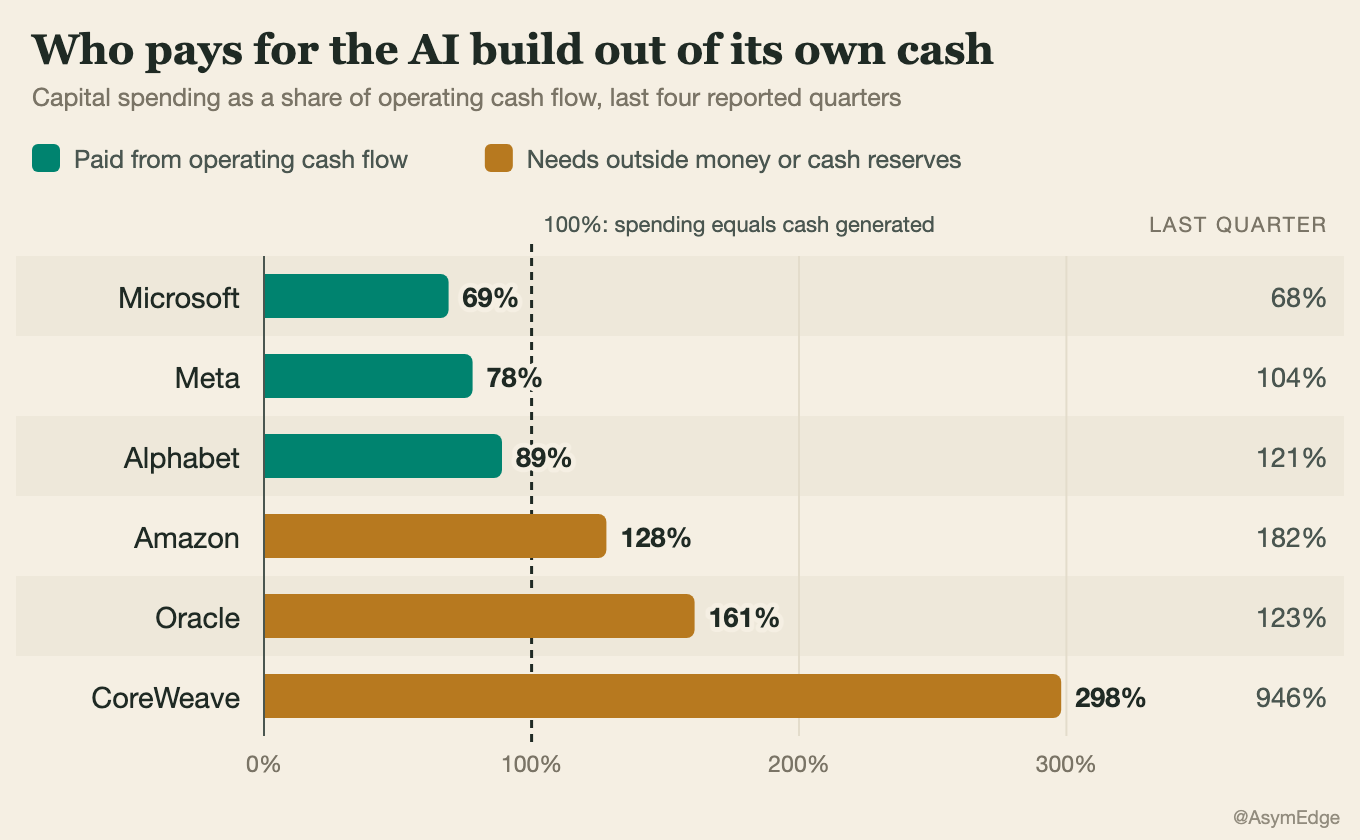
Capital spending is cash paid for property and equipment over each company's last four reported quarters (Oracle to August, CoreWeave to June). Assets taken on finance leases come on top. Source: company filings.
Government borrowing costs have fallen: the ten-year Treasury yield dropped from 5.28% to 4.84% over the month. Companies can still face higher borrowing costs if lenders demand more compensation for risk. The concern is what it costs individual companies to fund their projects.
Why I expect the build to continue
Recent reports from the largest buyers give me a broader reason to expect spending to continue. In the September quarter, Azure revenue rose 48%, AWS 39% and Google Cloud 103% year on year. These businesses include non-AI workloads, and Google's growth also included TPU system sales, but the figures show customers buying more capacity and services.
The investment plans remain large. Amazon kept its 2026 cash capital-spending forecast at about $220 billion. Microsoft expects capital spending above $50 billion in the December quarter and an acceleration in the second half of its fiscal year. Those plans support my view of continued demand for equipment, though plans still have to become deliveries.
The US-China race gives governments another reason to keep investing. The US AI Action Plan links infrastructure, exports and national security; China's AI Plus policy prioritizes computing capacity and adoption across the economy. That supports continued spending, although export controls and sovereignty requirements limit which suppliers benefit and where capacity can go.
The fear after the midterms is that tighter rules could block or delay US data centers. I do not think that automatically means less AI investment worldwide. Companies can choose other locations for future projects, especially for training AI models, which is less tied to where customers live. But relocating takes time: the IEA estimates two to three years to develop a data center, with power infrastructure often taking longer.
Microsoft also illustrates the weakness in my argument. Some third-party capacity expected in the September quarter was delayed into the second half of its fiscal year. Even a buyer with cash and customers cannot make every project arrive on time. Global spending can survive while supplier earnings arrive later than forecast.