
Jensen Huang leaves Nvidia. What happens to the AI trade?
Jensen Huang’s exit puts Nvidia’s customer financing in focus. Can it take less risk without losing chip sales, and what does Friday’s price already discount?
|
Weekly · the market and its twelve most-traded stocks
Jensen Huang leaves Nvidia. What happens to the AI trade?
Since last week’s letter, Jensen Huang has left Nvidia and longtime finance chief Colette Kress has become interim CEO.
My view: Nvidia helps finance some of the companies that buy and use its chips. Reducing that support could preserve cash and limit new risk, but customers might buy fewer chips unless they find replacement funding. If profitable sales and payments hold up with less Nvidia backing, investors could reward those more dependable earnings with a higher valuation multiple. The question is whether that improvement outweighs any growth lost.
Reuters reported that Kress had challenged some financing deals, although she publicly supported customer financing in August. By Sunday, Reuters, citing the Financial Times, was also reporting that Huang had discussed a possible return and that allies were lobbying for his reinstatement. Who leads the company matters because it could change how much financial backing customers receive.
Between the 6 and 13 November closes, Nvidia fell 12.7%, while the Nasdaq-100 ETF QQQ rose 3.6% and chip ETF SMH gained 4.9%. Neoclouds, which rent out AI computing power, diverged: CoreWeave gained 14.5%; Nebius lost 10.5% and IREN 16.0%.
Company news helps explain the split: CoreWeave raised its revenue outlook, Nebius reported capacity delays, and IREN faced analyst downgrades after postponing a key revenue milestone. These are different challenges to growth, rather than a single verdict on AI demand.
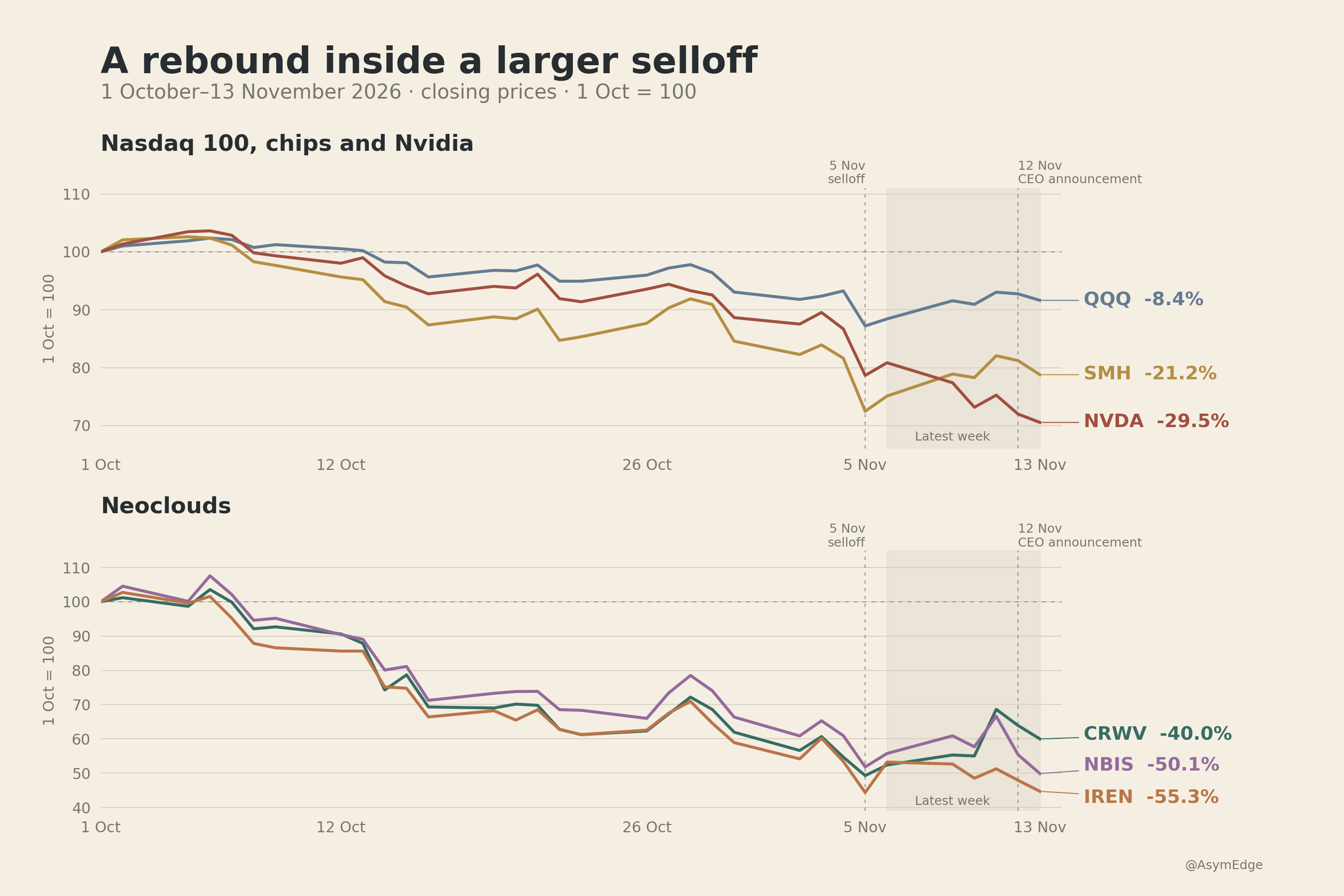
The rebound has not repaired the earlier damage. QQQ remains 10.5% below its early-October high and SMH 23.2% below. The sharp one-day fall came on 5 November: 6.5% and 11.2%, respectively.
Who pays for Nvidia’s next GPU order?
Nvidia supports customers through investments, guarantees and commitments to buy cloud capacity. That can help turn AI demand into funded equipment orders. Less support could therefore slow spending across the supply chain, from neoclouds to memory and networking suppliers.
One example explains the risk
Anthropic builds AI software; Nscale supplies the computing power, using Nvidia chips. Nvidia backs Nscale and proposes a $10 billion investment when Anthropic goes public. Anthropic, in turn, has agreed to buy up to $44.6 billion of computing services from Nscale through 2033. The IPO investment is conditional; service fees are earned as capacity is delivered.
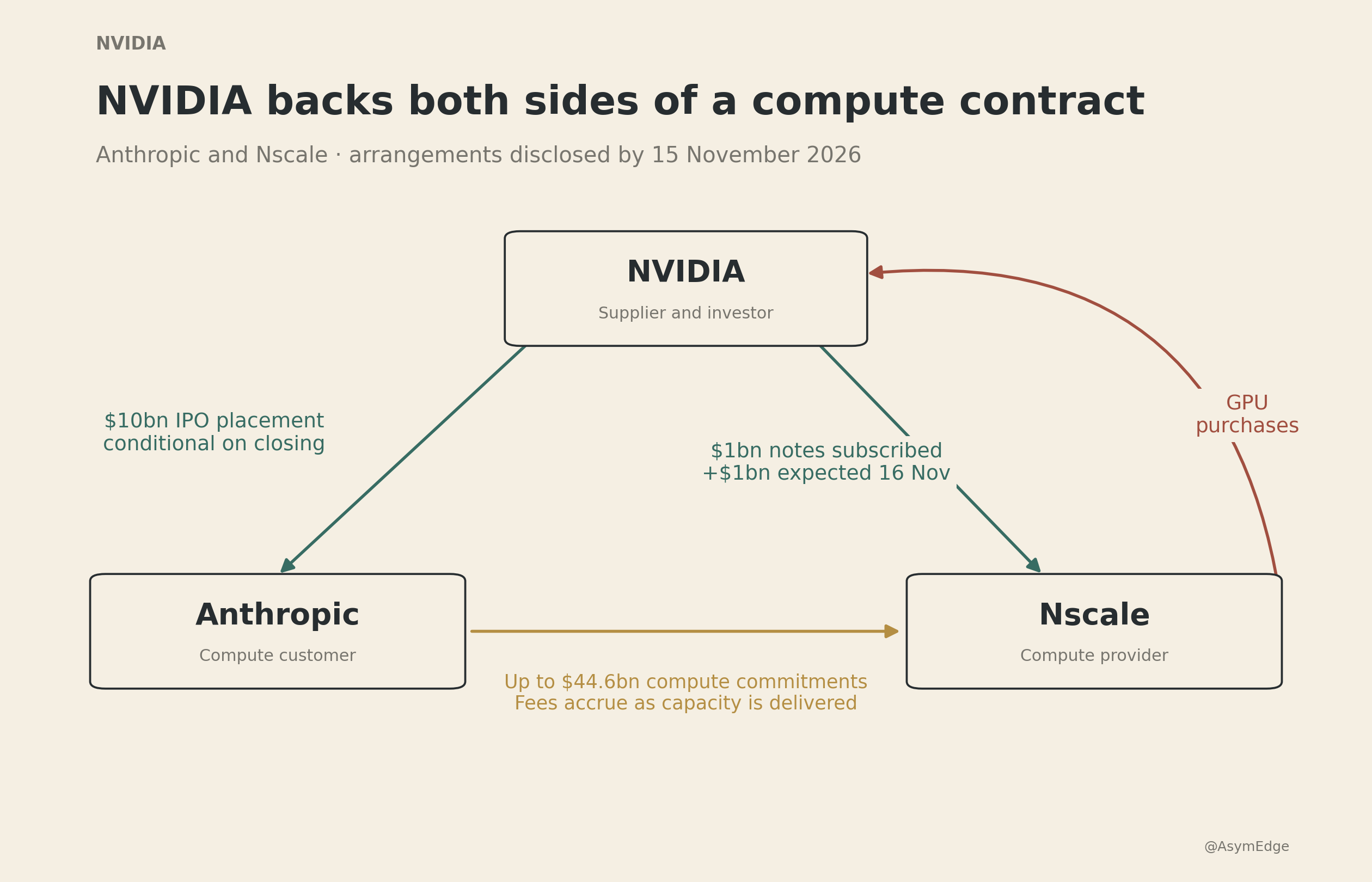
The key finding is in Nscale’s 12 November prospectus: it had not yet secured firm financing agreements for its Anthropic contracts. Management expected to arrange funding. A large customer contract can be in place before the project financing is firm.
If Anthropic spends less than planned, Nscale’s revenue, future Nvidia orders and Nvidia’s related investments could weaken together. The $44.6 billion service contract is not Nvidia chip revenue. The filing does not disclose Nvidia’s share of the equipment bill or how much further Nvidia support would be needed.
More cash for cloud operators does not always mean more chip sales
Customers have other ways to raise money. Nebius arranged a $775 million loan backed by GPUs it already owns and a contract with a financially strong customer. This shows that some funding is available, although it does not establish that Nebius can finance all its expansion without Nvidia.
Where that money goes matters. CoreWeave expects $9 billion in customer prepayments and deposits over the next three months. More than $3 billion relates to customers renewing their use of existing infrastructure. These are expected payments for future services, rather than profit already earned. The cash could help CoreWeave pay its bills without buying more Nvidia chips. Borrowing against existing GPUs can do the same. Nvidia gains new chip sales when funding pays for additional equipment.
Even a funded project can run late or prove expensive. Some Nebius capacity has been delayed into 2027 despite customer contracts remaining in place. CoreWeave’s quarterly net interest expense was about four times its operating profit. Access to money does not guarantee timely delivery or attractive profits.
What shareholders would actually gain
For Nvidia shareholders, there are two questions: how much cash does the company retain, and how much profit does it earn? Cutting new customer support could preserve cash. But if customers cannot replace that funding, Nvidia could lose profitable chip orders. Its earlier guarantees and purchase commitments would still remain.
For example, choosing not to invest $1 billion in a customer leaves Nvidia with $1 billion in cash instead of an investment. It does not add $1 billion to profit. It also leaves free cash flow unchanged under the definition used here: cash from operations minus capital spending. Equity investments are counted separately, and skipping them gives up potential investment returns.
The July quarter shows why saving on investments is only half the story. Nvidia spent less cash buying shares in other companies, yet cash generated by its operations fell from $50.3 billion to $24.1 billion. More cash was tied up in receivables: sales already recorded for which customers had not yet paid.
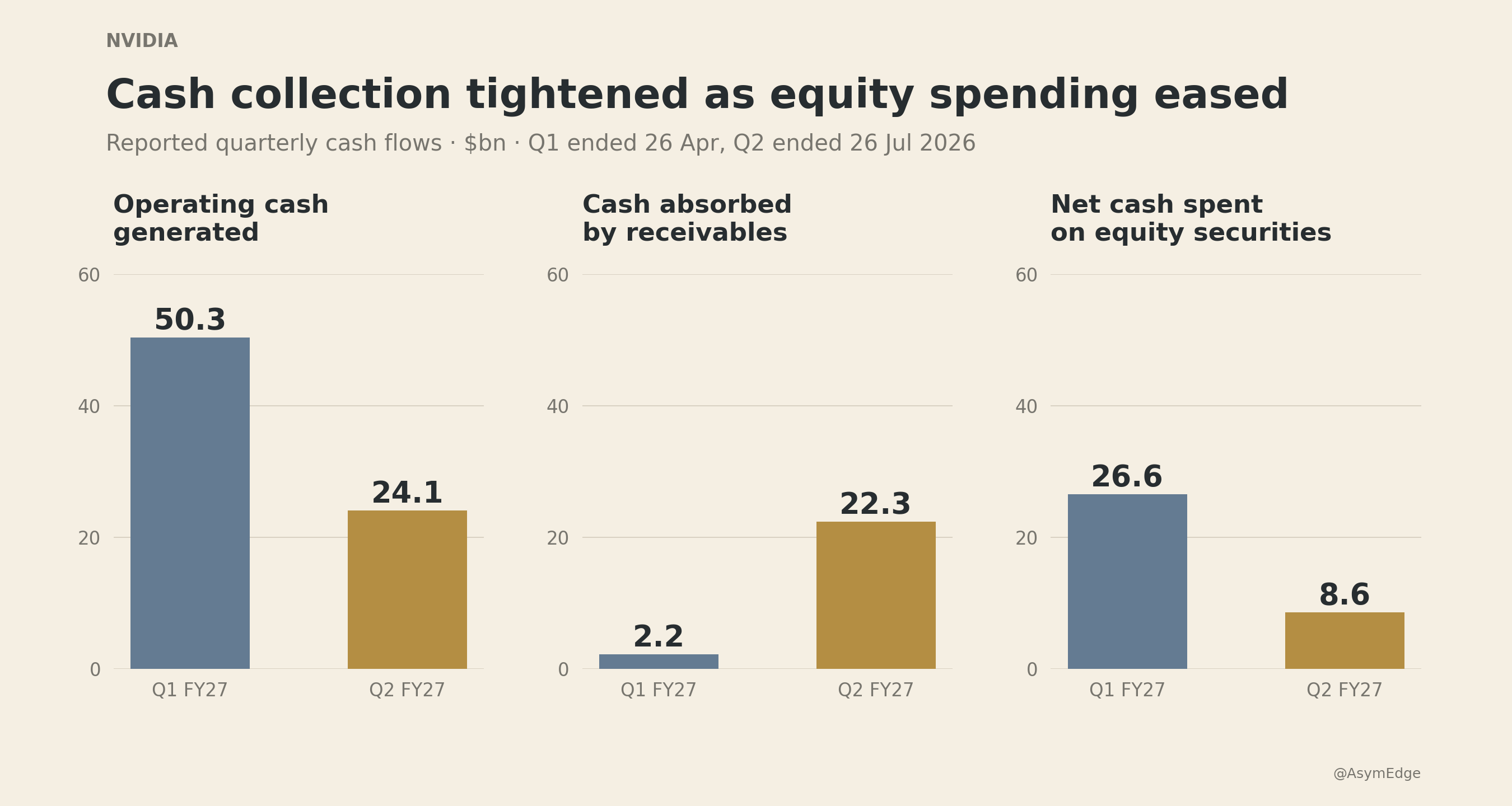
Nvidia said working capital and cash taxes caused the fall in operating cash flow. Giving some customers longer to pay helped explain why more cash was tied up in unpaid sales. These figures cover the whole company and do not show that neoclouds have stopped paying. Operating cash flow was still higher than a year earlier. The point is that Nvidia needs to collect cash as well as report sales.
If one customer postpones an order, another could buy the chips. But to make up the lost revenue, that buyer must purchase more than already forecast, within the same year and on comparable terms. Relying more on a few large cloud companies could make Nvidia more dependent on those customers. Separately, new leadership still has to deliver products on time and protect profit margins.
The opportunity for shareholders is that customers keep buying chips and paying their bills while Nvidia puts less of its own money at risk. More dependable profits could persuade investors to pay a higher price for each dollar of earnings, meaning a higher P/E. But that only helps if the higher valuation outweighs any profit lost through weaker sales. The scenarios below show the possible returns for someone buying at Friday’s closing price.