Meta grew 26% and fell 9%: AI spending gets a price
Meta grew revenue 26% and its shares fell 9.4% as quarterly capital spending reached $35 billion, while chips fell again and the rest of the market rose. Earnings estimates kept rising, and next week Microsoft, Alphabet, Amazon, Intel and Sandisk report within two days.
|
Weekly · the market and its twelve most-traded stocks
Meta grew 26% and fell 9%: AI spending gets a price
One change: from this issue on, The Free Letter records opens and link clicks, so I can see which research you find useful. To opt out, turn off images in your email app or unsubscribe. Details: www.asymedge.com/privacy/
Last week's letter asked whether the chip selloff was a valuation reset or a break in earnings. The second week points to the reset: four-week earnings estimates rose for 8 of the Twelve, and forward P/Es fell for 10 of them. Meta made the clearest case, and next week five of the Twelve report within two days.
1The market
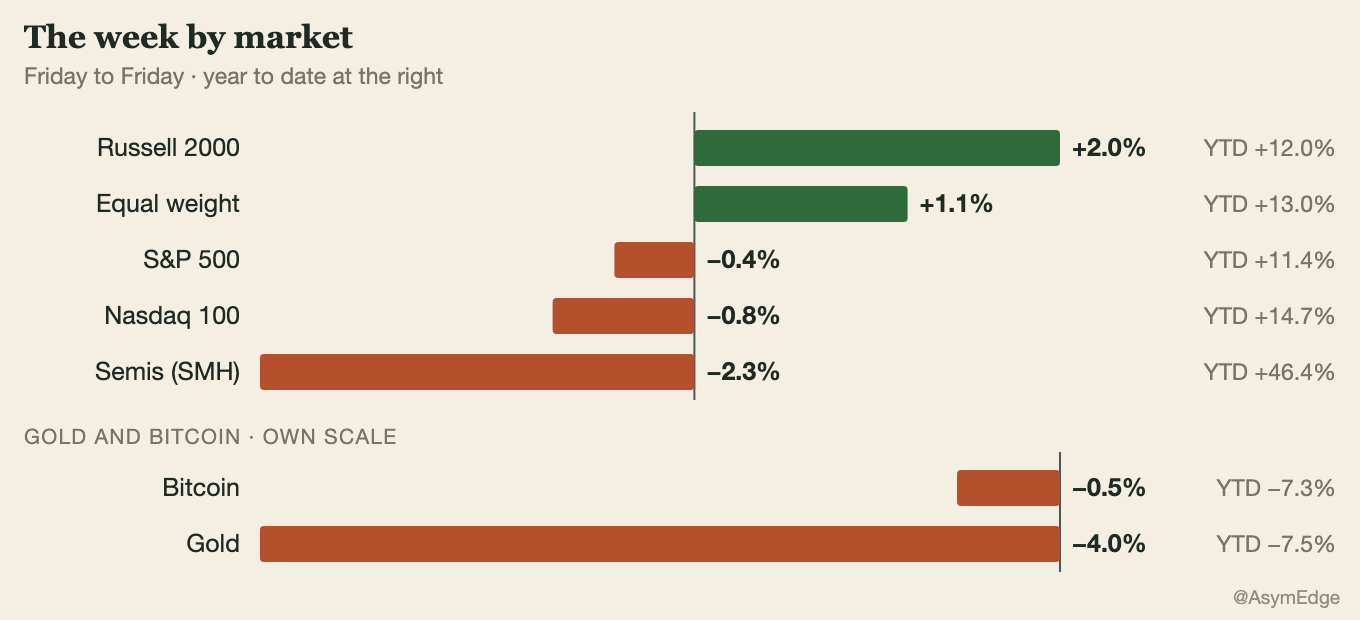
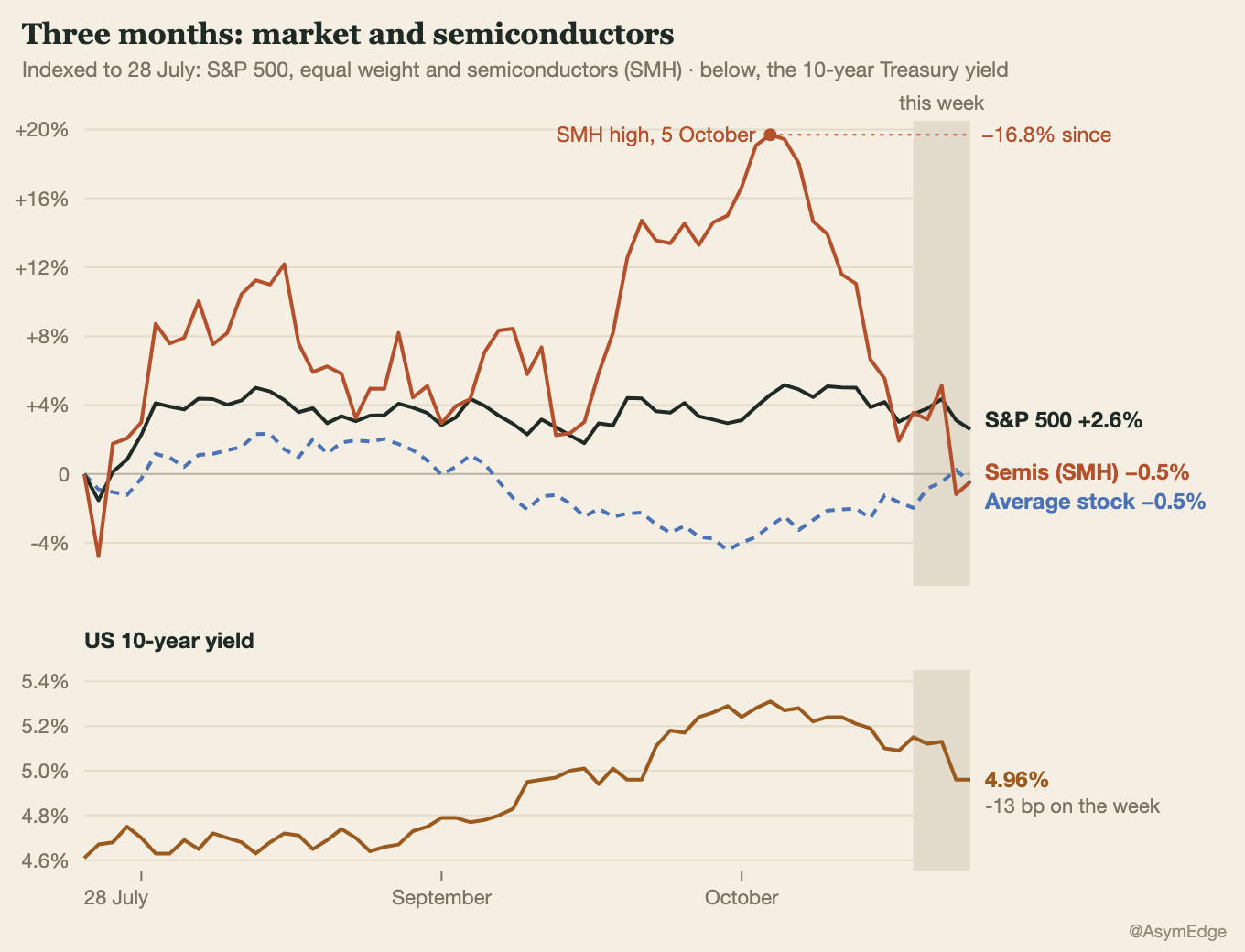
Technology carried the losses for a second week while the rest of the market rose. SMH fell 2.3% and the Nasdaq 100 0.8%; the equal-weight S&P 500 gained 1.1% and the Russell 2000 2.0%. The S&P 500 slipped 0.4% and ends the week 2.5% below its high. Gold fell 4.0%.
Thursday decided the week. SMH rose 3.1% from Monday to Wednesday, then fell 6.0% in a single session, with Sandisk down 8.5%, AMD 8.1% and Intel 8.0%. Meta, which reported Wednesday evening, fell 7.0% the same Thursday. Bonds rallied at the same time: the ten-year Treasury yield fell 17 basis points to 4.96%, and the inflation-adjusted yield 12 points to 2.64%. Lower yields did not hold up the chip multiples.
Market state
Market Data from Tiingo.com
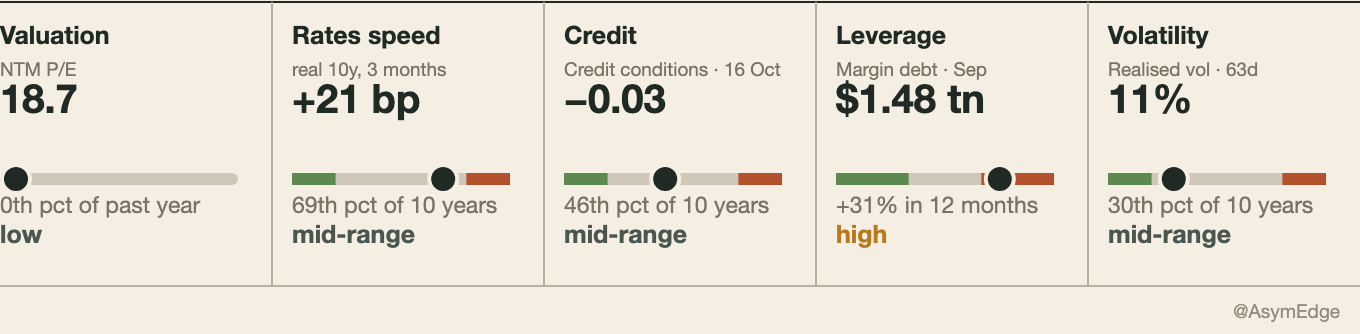
The S&P 500's forward P/E fell to 18.7 from 19.0, its lowest reading of the past year, while the index sits only 2.5% below its high. The two fit together because earnings forecasts kept rising as prices stalled. Investors now pay less for each dollar of expected profit than at any point in twelve months; the coming reports test whether those profits arrive.
One gauge changed. The inflation-adjusted ten-year yield's three-month rise halved, from 43 to 21 basis points, which moves rates speed from high to mid-range. Credit conditions sit near the middle of their ten-year range, and volatility over 63 trading days is 11%. Margin debt remains the one high reading: $1.48 trillion in September, up 31% in a year. Since 2002, when that growth ran above 25%, a 15% drop came within the next twelve months 35% of the time, against 28% when borrowing was shrinking.